





Social Services, AI customization
Client:
Social Insurance Agency
Slovakia
Slovakia
Tags:
Social Services, AI customization
Case Study: Social Insurance Agency Branch Network Optimization
How can a national institution serve millions of citizens more efficiently without sacrificing service quality? We helped Slovakia's Social Insurance Agency design a predictive simulation model to optimize their front-office operations across 88 branches — balancing workforce capacity with real citizen demand.
Challenge
The Social Insurance Agency operates one of Slovakia's largest public service networks, handling everything from pension applications to disability assessments. With inconsistent workloads across branches, long waiting times at peak hours, and uneven staff utilization, the agency needed a data-driven approach to understand where bottlenecks occur and how to resolve them — without disrupting daily operations.
Beyond logistics, the challenge was human. Citizens expect quick, reliable service for life's most important moments — retirement, illness, unemployment. The agency needed to balance operational efficiency with the reality that every queue represents someone waiting for answers about their future.
Approach
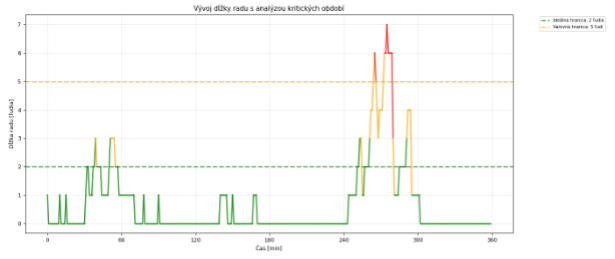
We built a discrete event simulation using Python's SimPy framework, modeling all 88 branches with their unique characteristics — opening hours, service types, staff, and predicted demand patterns. The model runs iterative scenarios to automatically optimize staffing levels based on target utilization rates, testing "what-if" scenarios without any risk to real operations.
The simulation transforms complex operational decisions into clear, actionable insights. It calculates optimal staff numbers per branch and day, identifies overloaded employees at risk of burnout, flags underutilized capacity, and predicts citizen departure rates — all before any changes are made in the real world.
Outcome
The predictive model now serves as a strategic planning tool for the agency's leadership. It enables evidence-based decisions about workforce allocation, branch opening hours, and service distribution — ensuring that the right number of staff with the right skills are available exactly when and where citizens need them most.
Beyond immediate efficiency gains, the tool reshapes how the agency thinks about service delivery. It connects predicted citizen behavior with operational capacity, turning reactive problem-solving into proactive planning — and ultimately, shorter queues and better experiences for millions of Slovak citizens.
Explore the full case
If you like to explore the full scope of this programme, contact us (link to a contact form) for more information.
Discover more impact stories
Public Administration, Economy, Strategic Advisory
Read more
Social Services, AI customization
Read more
Healthcare, Public Health, Strategic Advisory
Read more